
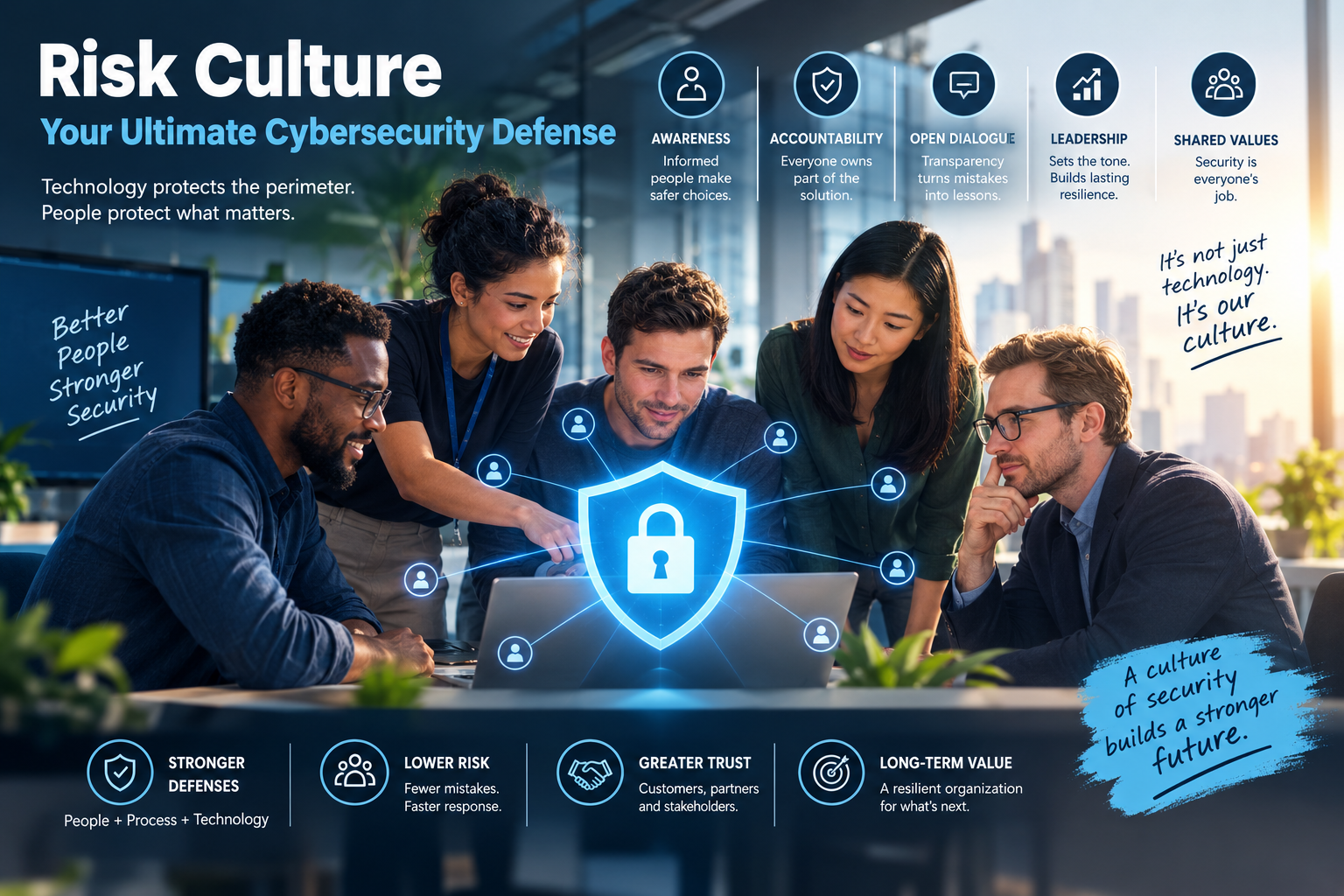
The Intangible Asset: Why Risk Culture Is Your Ultimate Cybersecurity Defense
The Intangible Asset: Why Risk Culture Is Your Ultimate Cybersecurity Defense
The human foundation of digital resilience
Risk culture represents the fundamental cybersecurity component that remains beyond the reach of traditional purchase orders.
Organizations frequently invest millions in sophisticated defense systems while overlooking the human element that governs those tools.
Real security stems from the collective habits and shared beliefs of every individual within the enterprise. When employees view protection as a shared responsibility, the organization gains a level of resilience that technology alone fails to provide.
True safety exists when people prioritize security during their daily routines. Leaders must recognize that tools operate effectively only when paired with a vigilant and informed workforce.
Security represents a living practice rather than a static product. Success relies on the alignment of individual actions with organizational goals.
Every interaction with a digital asset involves a choice that either strengthens or weakens the perimeter. Cultivating this mindset requires continuous effort and clear communication.
Human behaviors serve as the primary catalyst for organizational vulnerabilities. Most security incidents originate from simple actions like clicking a malicious link or reusing a common password.
A strong culture transforms cybersecurity from an external requirement into an internal value. This shift ensures that protection remains a priority even in the absence of direct supervision.
Bridging the gap between policy and practice
Policies often remain theoretical documents until they encounter the reality of daily operations and business pressure.
Many organizations maintain impressive manuals that describe perfect procedures while staff follow entirely different shortcuts to meet deadlines. This divergence creates a hidden layer of risk that remains invisible on standard dashboards.
True resilience requires that controls reflect actual work practices. When a security measure hinders productivity, employees often find creative ways to bypass it.
Leaders must ensure that safety protocols simplify rather than complicate the workflow. Effective risk management depends on the willingness of staff to report errors immediately and transparently.
A culture of psychological safety encourages transparency and rapid response to potential threats. Open dialogue regarding mistakes allows the organization to learn and adapt before a minor issue becomes a major crisis.
Accountability must be clearly defined to ensure that everyone understands their specific role in maintaining the integrity of the system. Ambiguity in ownership leads to gaps in defense that attackers easily exploit.
The presence of a formal policy remains secondary to the actual behavior of the staff. Authenticity in risk management requires that actions consistently match the written word.
Leadership influence and the federated strategy
The tone established by executives determines the priority of risk management throughout the entire organization.
When leaders emphasize speed and revenue at the expense of security, they signal to the staff that resilience is secondary. Integrating risk into the enterprise strategy requires a commitment to long term stability.
In a federated operating model, individual business units must take ownership of their specific risk profiles while adhering to a central framework. This structure provides flexibility while maintaining a high standard of protection across the entire enterprise.
Artificial intelligence introduces new complexities that require a comprehensive view of cumulative risks and shared dependencies. Managing these advanced technologies calls for a shift from isolated assessments to an integrated enterprise perspective.
Leaders must champion the idea that cyber risk is a core business risk comparable to financial or operational risks. Consistent messaging from the top ensures that every department aligns with the overall risk appetite.
Rewarding security conscious behavior reinforces the importance of these values. Performance metrics should include adherence to safety standards to ensure that incentives align with organizational health.
The image of a hacker in a hoodie often obscures the reality that most vulnerabilities stem from organizational behavior. Incidents like stolen credentials or exposed data usually trace back to weak processes and unclear responsibilities.
Preparation for certifications such as the CRISC demonstrates a commitment to mastering IT risk management at a professional level. However, even the most certified individuals require a supportive culture to be effective.
Strategic governance for boardroom impact
Effective governance demands an independent voice and a clear understanding of business impacts. Board members must move beyond technical metrics to focus on customer trust, operational continuity, and regulatory compliance.
Describing risks in business terms allows for better decision making and resource allocation. Boards should regularly evaluate how incidents align with the stated risk appetite of the organization.
High volumes of minor issues often indicate systemic cultural weaknesses that require intervention. Independent oversight ensures that the executive team remains accountable for the security posture of the company.
Clear definitions of risk tolerance provide a roadmap for management to follow during periods of rapid growth. Asking material risk takers about their specific responsibilities reveals the true state of accountability within the firm.
Relying solely on annual attestations provides a false sense of security. Direct engagement with the people who manage critical assets yields deeper insights into the health of the risk culture.
Governance structures must remain agile enough to address emerging threats like those posed by AI and cloud adoption. A robust framework supports innovation by providing clear boundaries for safe experimentation.
Tactical integration for operational success
Specific levers exist to help risk and privacy professionals shift the cultural needle within their teams.
Audit teams should focus on testing actual behaviors and outcomes rather than just the design of controls. Observing how employees handle access revocations or software sign ups provides a realistic view of policy adherence.
Risk teams must link potential failures to cultural drivers like incentives and process friction. Identifying the root cause of a bypass allows for more effective remediation.
Privacy professionals can integrate safety checklists directly into product development cycles to make compliance the default path. This proactive approach reduces the burden on staff and increases overall protection.
Cybersecurity teams must collaborate with business heads to create a common language for discussing threats. This shared vocabulary bridges the gap between technical specialists and operational leaders.
Small, consistent actions collectively build a robust defense against evolving threats. Organizations that remain curious and humble regarding their vulnerabilities stay ahead of the curve.
True value emerges when security becomes an intrinsic part of the professional identity of every employee. Continuous learning and adaptation are the hallmarks of a mature risk culture.
Organizations must avoid the trap of hubris by recognizing that security is a continuous journey. Constant improvement and cultural alignment provide the strongest defense against the unknown.
The path forward
Building a resilient organization requires a shift from viewing cybersecurity as a technical hurdle to treating it as a cultural imperative. While tools and software provide the necessary infrastructure, the mindset of the workforce determines the ultimate effectiveness of those defenses. Leaders who foster an environment of transparency, accountability, and continuous learning create a sustainable advantage. Security remains a human endeavor that thrives on shared values and consistent action. By prioritizing risk culture, an organization protects its assets, its reputation, and its future.
Which specific cultural habit within your organization currently provides the strongest defense against emerging digital threats?
#RiskCulture #CybersecurityStrategy #EnterpriseRiskManagement #Leadership